Default username/password for PostgreSQL server in Rails 4
USERNAMEMany PostgreSQL users may be asked for their database settings
for the first time when logging in PASSWORD. However, just learning these settings is not all you need to know.
What is the server in Rails 4? The server in Rails 4 uses Ruby on Rails 4the PostgreSQL server with .
Hence, the backend is integrated with the frontend application using RORthe framework ( short for javascript).Ruby on Rails
Today we will dive into the basic setup of PostgreSQL and the default user configuration before that.
Initial configuration and setup of PostgreSQL
When you run PostgreSQL setup for the first time, you will encounter a similar situation.
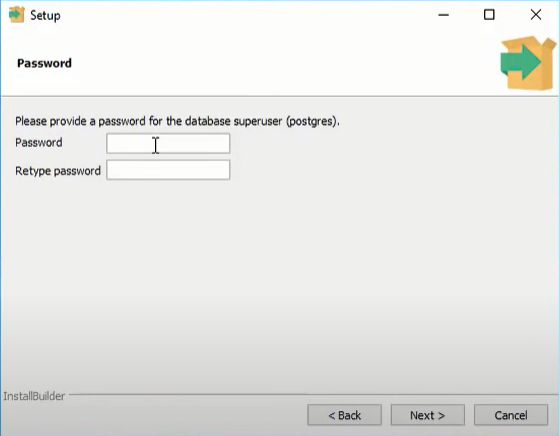
It asks you for a password called POSTGRES. SUPERUSERSo when you open PGADMIN4or the console version PSQL, you will now need to log in with the username POSTGRESand the password you entered above.
How do I use PGADMIN4Login?
-
start up
PGADMIN4. -
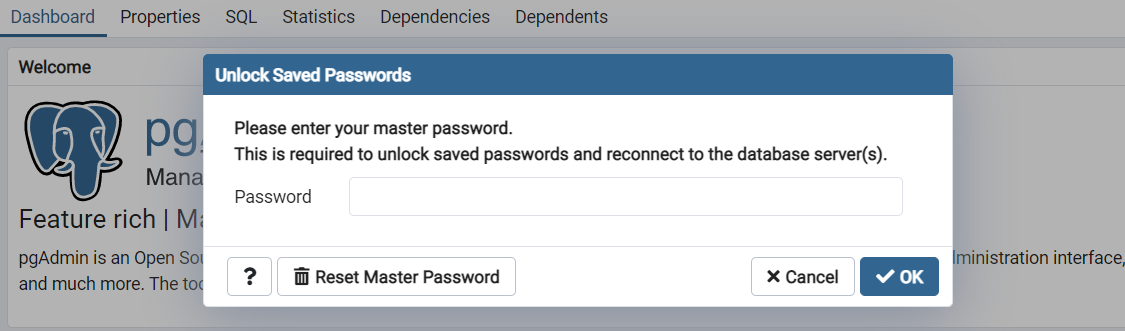
On the startup screen, you will see the following.
-
Here you will enter the password you used during setup to log in.
If you forget your password, you can simply click
RESET MASTER PASSWORDand follow the on-screen instructions.
Now we will learn how to PSQLlog in using .
-
Open
CMDand run it with user privileges. -
In
CMD, enter:``cmd
C:\Users\User_Name > cd C:\Program Files\PostgreSQL\14\bin或由你的系统指定。而不是 `14`,可能有不同的版本和不同的目录来打开 `bin` 文件夹。 -
Now you are
目录in , enterpsql.exe.``cmd
C:\Program Files\PostgreSQL\14\bin> psql -U postgres
The above statement tends to turn on the as usernamewith , which is our default .psqlpostgressuperuser
- This will guide you to:
Password for user postgres:
Here you will enter setupthe same password you set in to log in and click Enter. You are now logged in.
Superusers in PostgreSQLPOSTGRES
POSTGRESIt is the root of our database SUPERUSER. It has all known permissions to access and view the entire database objects, views, etc.
You can publish your SUPERUSERSor just those with limited access USERS. SUPERUSERis the only CREATEentity that can issue commands to add new users to the system.
Creating differentUSERS
You can create a new one with a unique name using the following statement SUPERUSER.
Create ROLE Wild_Cat WITH SUPERUSER
Or if you want to log in.
Create ROLE Wild_Cat Login
Then psqllog in using .
USERSView and ALTERForgot Password
in PostgreSQL
If you have different ones USERS, you can view them as follows.
select * from pg_user;
Then, from the provided list, such as in our example we have user WILD_CAT, use ALTERthe statement to get RESETthe password.

From here, we can ALTERcall the statement as:
ALTER USER wild_cat WITH PASSWORD '[your_password]'
So today, we SERVER IN RAILS 4have seen various ways in which we can define and use SQL in PostgreSQL USERS. We hope that you will continue to learn and follow our tutorials to better understand the concepts behind different solutions to the problem.
For reprinting, please send an email to 1244347461@qq.com for approval. After obtaining the author's consent, kindly include the source as a link.
Related Articles
Terminate the PostgreSQL connection
Publish Date:2025/04/11 Views:199 Category:PostgreSQL
-
In this article, we will learn how to terminate a PostgreSQL session. Any open connections are run by background processes or tasks, PSQL which may no longer exist despite exiting the user interface or command line tool. Use ps -ef or grep
Single query to rename and change column type in PostgreSQL
Publish Date:2025/04/11 Views:166 Category:PostgreSQL
-
This article describes how to rename a column and change its type in PostgreSQL using only a single query. Renaming and changing column types in MySQL In MySQL , if you want to change the column type and rename it, you can use a simple stat
Joining columns using Select in PostgreSQL
Publish Date:2025/04/11 Views:176 Category:PostgreSQL
-
MySQL PostgreSQL is an object-relational database system, which means it can support more complex data types than its competitors . Today we will learn how to use SELECT the operator to join the columns of a table. Using operators to || joi
Using CASE in PostgreSQL
Publish Date:2025/04/11 Views:124 Category:PostgreSQL
-
This article shows how to use the statement in PostgreSQL CASE . CASE How to use the statement in PostgreSQL case Statements are similar to those in general-purpose programming languages if-else . But in SQL, if you want to write IF-ELSE ,
Using NOT IN with subqueries in PostgreSQL
Publish Date:2025/04/11 Views:93 Category:PostgreSQL
-
NOT IN The inverts the result of NOT simply using IN the operator. NOT IN The right side of the operator must have a subquery in which multiple columns are returned to check whether the expression matches the data. NOT IN Tends to return tr
Using variables in PostgreSQL
Publish Date:2025/04/11 Views:171 Category:PostgreSQL
-
This article will demonstrate how we can declare and assign values to variables in PostgreSQL. In PostgreSQL, DECLARE variables are declared using Often you will need variables in your PL/SQL scripts. In DECLARE the section called , y
Connect to PostgreSQL using a password
Publish Date:2025/04/11 Views:171 Category:PostgreSQL
-
This article shows various ways to connect to PostgreSQL using a password. It can be through the command line, pgpass a file, PGPASSWORD an environment variable or a connection string. Connecting to PostgreSQL with a password using the comm
Deleting a database in PostgreSQL via PSQL
Publish Date:2025/04/11 Views:166 Category:PostgreSQL
-
There are two ways to access PostgreSQL objects and databases on your system. One is through an interface, such as a graphical interface like PGADMIN, and the other is the basic command line tool psql. Today, we will look at DROP DATABASE t
Using the database in PostgreSQL
Publish Date:2025/04/11 Views:132 Category:PostgreSQL
-
This article demonstrates connecting to a database, creating a new database, and creating a table in PostgreSQL. Available databases in PostgreSQL You can run the following command after opening the Postgres command line to view all availab